
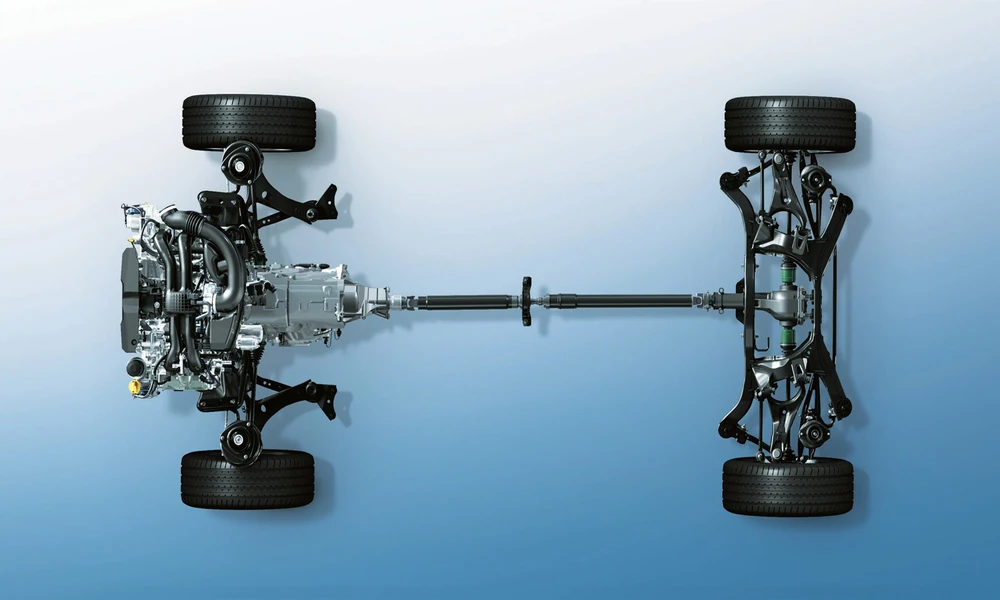
Subaru transmissions and the all-wheel-drive puzzle

Subaru built its identity on two things: the horizontally opposed boxer engine and symmetrical all-wheel drive. That combination is what gives a WRX its planted, point-and-go character in the rain or on gravel. It also makes the transmission a more involved subject than on a typical front-driver, because a Subaru gearbox is not just managing gears. It is the heart of a drivetrain that sends power to all four corners. Replace one without understanding the system and you can create problems that did not exist before.
For anyone repairing or building a Subaru, the transmission deserves the same careful thought as the engine it bolts to.
Why Subaru transmissions are different
In most all-wheel-drive Subarus, the transmission and the center differential live together, integrating the front and rear power split into one unit. This is the mechanical basis of the symmetrical AWD system. It also means a Subaru manual or automatic is doing more work and carrying more complexity than a comparable two-wheel-drive transmission.
That integration has consequences for replacement. The unit has to match not just the engine and the bellhousing pattern, but the final drive ratios front and rear so the system stays balanced. A mismatched final drive can cause driveline bind and accelerated wear. This is why matching a Subaru transmission correctly is less forgiving than on many other cars, and why sourcing from a catalog of Subaru JDM transmissions organized by model and year matters so much. Getting the ratios right is not a detail you can paper over later.
Manual versus automatic in the Subaru world
The enthusiast heart of the brand beats in the manual cars. The five-speed and six-speed manuals behind the turbocharged engines, particularly in the WRX and STI, are central to the driving experience these cars are famous for. The six-speed found in the STI is the stronger unit, built to handle the higher torque of the performance models, and it is a coveted piece for builders pushing serious power.
The automatics and later CVT-based systems serve the broader lineup of Foresters, Outbacks, and Legacys that make up most of Subaru’s sales. These have their own service considerations, and the CVT in particular is a different animal that rewards diligent fluid maintenance. For a performance build, though, the conversation almost always centers on the manuals.
Matching the transmission to your power goals
Here is where Subaru builders need to be honest with themselves. The boxer engines, especially the turbocharged EJ family like the EJ255 and EJ257, can be pushed to power levels the stock drivetrain was never designed to handle. A transmission that was perfectly happy behind a stock WRX may not survive behind a heavily modified one.
If you are building power, the transmission has to be part of the plan, not an afterthought. Stepping up to a stronger STI six-speed, or reinforcing the unit you have, is standard practice for builds chasing real numbers. When you are sourcing a replacement or an upgrade, search by model so the unit matches both your engine and your ambitions, rather than reusing a tired box that becomes the weak link the first time you launch hard.
The same JDM supply that makes Subaru engines accessible applies to the transmissions. Units pulled from Japanese-market cars retired early under the shaken inspection system arrive with the low mileage that makes them attractive replacements.
Common Subaru transmission problems to watch for
Subaru drivetrains are durable, but they have characteristic failure points worth knowing. On the manuals, hard launches and aggressive driving take a toll, and synchros wear with age and miles. The turbocharged cars, driven the way their owners tend to drive them, see more stress than a typical commuter transmission.
Clutch health is closely tied to transmission longevity on the manuals, and a slipping or abused clutch can lead to further damage if ignored. On the AWD system as a whole, mismatched tire sizes are a quiet enemy. Because the system expects all four wheels to rotate at matched rates, running tires with significantly different diameters or tread wear can stress the center differential and driveline over time. It is a maintenance detail many owners overlook until it becomes expensive.
The tire mistake that wrecks Subaru drivetrains
That last point deserves its own warning, because it catches more Subaru owners than any transmission defect ever will. Symmetrical all-wheel drive assumes all four tires are rotating at the same rate. When they are not, the drivetrain has to absorb the difference, and over time that stress damages the center differential and related components. The most common cause is innocent. An owner replaces one or two damaged tires and leaves the others worn, mixing diameters across the car.
The rule is simple and worth taking seriously: replace Subaru tires as a full set, keep them matched in size and tread depth, and stay on top of rotations. A blown tire on a low-mileage set is a frustrating case, and some owners shave a single new tire to match the others rather than risk the mismatch. It sounds fussy, but the cost of a set of tires is trivial next to the cost of a damaged AWD driveline. Many Subaru transmission and differential failures that get blamed on the gearbox actually started with mismatched rubber.
Keeping a healthy unit healthy
If your Subaru transmission is still working well, the goal is to keep it that way. Use the correct fluid specifications for the gearbox and differentials, and change them on a sensible schedule rather than treating them as lifetime fills. Treat the clutch on a manual as the wear item it is, and address a slipping clutch before it damages anything beyond itself. Pay attention to how the car behaves on tight, low-speed turns, since binding or shuddering there can signal driveline trouble worth investigating early. Caught soon, these issues are manageable. Ignored, they compound into the kind of repair that makes owners consider selling the car.
Doing the swap right
A clean Subaru transmission replacement follows a few firm rules. Match the unit precisely to your engine, drivetrain, and final drive ratios. Replace the clutch while the transmission is out on a manual, since revisiting it later means pulling everything again. Refresh seals and use the correct fluid specification. Inspect and address driveline components rather than reusing worn parts on a job you do not want to repeat. And on a performance build, size the transmission to the power you actually intend to make.
Subaru’s engineering gives you a genuinely special platform. The boxer and AWD combination delivers a driving feel that has earned a fiercely loyal following, from rally fans to all-weather commuters. The transmission is the linchpin that holds that experience together, so it deserves real attention when the time comes to repair or upgrade. Match it carefully, support it properly, and your Subaru keeps doing the thing it does better than almost anything else on the road.
