
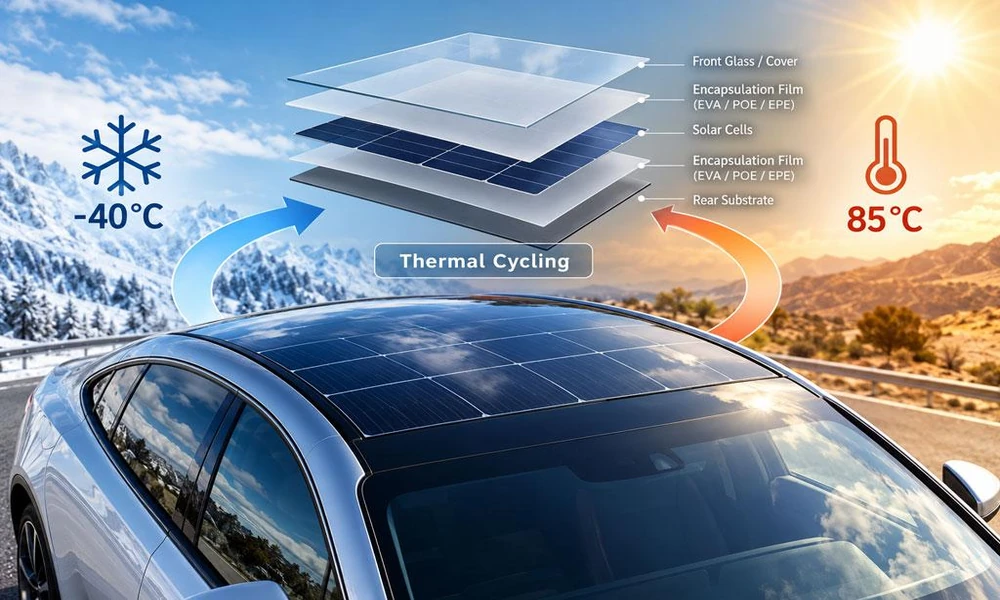
Understanding Thermal Cycling Requirements for Automotive Solar Encapsulation Films

As solar technology becomes increasingly integrated into electric vehicles (EVs), automotive manufacturers are exploring photovoltaic (PV) systems for vehicle roofs, hoods, and other exterior surfaces. These applications introduce demanding environmental conditions, particularly repeated temperature fluctuations caused by sunlight, weather changes, and vehicle operation.
Thermal cycling resistance is a critical performance requirement for automotive solar encapsulation films, as it directly influences module durability, adhesion stability, electrical insulation, and long-term reliability.
Understanding thermal cycling requirements helps automotive engineers and solar module manufacturers select suitable solar encapsulation films.
What Is Thermal Cycling in Automotive Solar Modules?
Thermal cycling refers to repeated exposure to alternating high and low temperatures. As temperatures change, different materials within a photovoltaic module expand and contract at different rates.
A typical automotive solar module consists of several layers, including:
- Front glass or transparent polymer cover
- Solar cells and electrical interconnections
- Encapsulation films
- Rear protective substrate
- Electrical insulation and supporting structures
Because these materials have different coefficients of thermal expansion (CTE), repeated temperature changes generate mechanical stress at their interfaces.
Over time, accumulated stress may contribute to encapsulation delamination, cell cracking, solder fatigue, and deterioration of electrical insulation.
Unlike conventional rooftop photovoltaic installations, automotive solar modules may also experience vibration, mechanical bending, and rapid temperature changes during vehicle operation.
Why Thermal Cycling Resistance Matters for Automotive Applications
1. Preventing Encapsulation Delamination
Solar encapsulation films bond solar cells to surrounding protective layers. Repeated expansion and contraction can weaken these interfaces, particularly when the materials have significantly different thermal expansion characteristics.
Strong adhesion and stable mechanical properties help maintain module integrity throughout temperature fluctuations.
2. Protecting Solar Cells and Interconnections
Solar cells are relatively brittle, especially when manufacturers use thin crystalline silicon wafers to reduce module weight.
Temperature-induced mechanical stress can contribute to microcracks and interconnection fatigue.
A properly selected encapsulation film provides mechanical cushioning and helps distribute stress across the module structure.
3. Maintaining Electrical Insulation
Automotive solar modules must maintain electrical safety despite repeated thermal exposure.
Thermal aging, moisture ingress, and interfacial degradation can compromise insulation performance. Encapsulation materials therefore require stable dielectric properties and resistance to environmental deterioration.
Thermal Cycling Standards and Testing Requirements
Several international standards provide useful references for evaluating photovoltaic module reliability.
IEC 61215 Thermal Cycling Test
IEC 61215 includes thermal cycling procedures for evaluating the design qualification of terrestrial photovoltaic modules.
A commonly used qualification sequence involves:
| Test parameter | Typical IEC 61215 reference |
|---|---|
| Minimum temperature | −40°C |
| Maximum temperature | +85°C |
| Thermal cycles | 200 |
| Temperature transition | Controlled heating and cooling |
| Electrical monitoring | Continuity monitoring where specified |
| Evaluation | Visual, electrical, and insulation-related checks |
These conditions are commonly associated with the TC200 test.
However, IEC 61215 is a photovoltaic module qualification standard, not a complete automotive qualification standard. Vehicle-integrated solar modules may require additional testing based on automotive manufacturer specifications.
Automotive-Specific Testing Considerations
Automotive solar modules can face operating conditions beyond those represented by conventional PV qualification tests.
Depending on module location and vehicle design, manufacturers may evaluate:
- Extended temperature exposure approaching +105°C or higher
- Additional thermal cycles beyond TC200
- Combined thermal cycling and vibration
- Humidity exposure and moisture resistance
- Mechanical fatigue in curved or flexible module structures
Standards such as ISO 16750-4 provide environmental testing guidance for electrical and electronic equipment in road vehicles. Their applicability to a particular solar module must be determined from its installation and qualification requirements.
Test limits and cycle counts should be established through application-specific engineering validation rather than assumed to be universal automotive requirements.
Key Factors Affecting Thermal Cycling Performance
Several material characteristics should be evaluated during encapsulation film selection.
Adhesion retention: Encapsulation films must maintain sufficient bonding strength after repeated thermal expansion and contraction.
Elasticity and modulus: Mechanical flexibility helps accommodate differential expansion, although excessive stiffness or softness may introduce other reliability concerns.
Crosslinking stability: For crosslinkable formulations, appropriate curing is essential for maintaining mechanical properties during long-term thermal exposure.
Moisture resistance: Low moisture permeability helps reduce corrosion and insulation degradation during combined thermal and humidity exposure.
Optical stability: Films should maintain high light transmission and resist discoloration to minimize photovoltaic power losses.
Best Practices for Automotive Solar Module Manufacturers
Reliable thermal cycling performance requires coordinated material selection, module design, and process control.
Manufacturers should evaluate complete laminated module samples rather than relying exclusively on standalone film properties.
Testing should include adhesion measurements, electroluminescence inspection, insulation resistance, and electrical power measurements before and after thermal cycling.
For curved automotive roofs, additional mechanical fatigue and vibration testing may be necessary.
Accelerated aging programs should also consider combined environmental stresses because temperature cycling alone cannot reproduce every condition encountered during vehicle service.
